Hello world, I’m Thariq 👋
Experienced software engineer with a passion for solving problems and breaking stuffs. My blog explores real-world tech challenges I faced and hobby projects I worked on.

Summary This is a complete account of standing up Ente — an end-to-end encrypted photo and video backup service — on a home server, exposed to the internet through a Cloudflare Tunnel, with mobile and web clients connecting to it from arbitrary networks. The straightforward part of this project was running docker compose up. The interesting part, and the reason this write-up exists, is a single architectural constraint that determines almost every other decision in the stack: Ente’s storage layer issues AWS SigV4 pre-signed URLs directly to the client, and pre-signed URL validation is byte-for-byte sensitive to header mutation along the request path. Any reverse proxy sitting between the client and the object store is a candidate for silently breaking uploads and downloads — and Cloudflare’s edge, which every hostname routed through a Cloudflare Tunnel passes through, is exactly this kind of proxy. ...
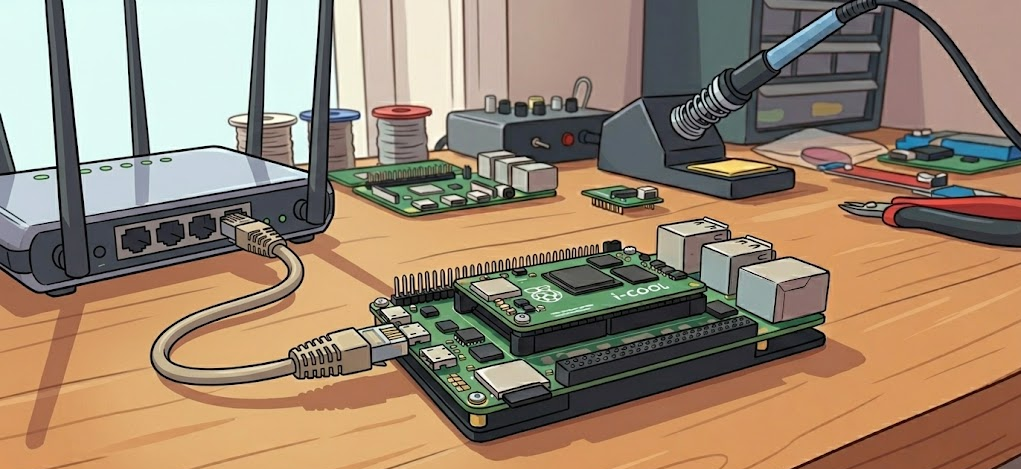
Why did I do this? Like always being bored is the reason for anything I do with tech. With the AI hype threatening my job (LOL), I wanted to play around with LLMs for actual daily use and not just generating slop. Since I own FriendlyElec’s CM3588 board with RK3588 with 32GB ram and 256GB storage it was overkill for my home lab use with CF tunnel, K3s cluster and containers just serving me my flac files, Immich and occasional side projects which I never use. I was aware that this board has an NPU but I never had the time to play with it and run a model off it. I did try ollama in my desktop but it never made any sense because of the resource usage and power consumption. ...
🔐 TLS Certificates for Homelab Using Cloudflare + Cert-Manager + Let’s Encrypt With Traefik operational as the ingress controller in a K3s cluster, the next logical step is to provision HTTPS automatically using Let’s Encrypt certificates, Cloudflare DNS validation, and Cert-Manager. This ensures encrypted traffic across services in a self-hosted homelab. ☁️ Prerequisites A domain managed by Cloudflare An API token with DNS edit permissions Traefik installed and configured as the ingress controller A functional K3s cluster with outbound internet access 🔧 Step 1: Install Cert-Manager Install cert-manager using Helm ...

🚀 Self-Hosting with K3s and Traefik Set up a lightweight Kubernetes cluster using K3s on a Raspberry Pi, deploy Traefik via Helm, and prepare for self-hosted services with ingress routing and local TLS. 🧰 Prerequisites A Linux host with root access (e.g., Raspberry Pi or any ARM64/x86_64 board) kubectl installed on a client machine Helm 3 installed on the cluster (https://helm.sh/docs/intro/install/) ⚙️ Install K3s without Traefik Skip the bundled Traefik and gain full control by managing ingress via Helm ...

🚀 Running the Valheim Server Using Docker Compose The Docker Compose configuration we used to deploy a Valheim server on the FriendlyELEC CM3588 board/Arm SBC version: "3" services: raspiheim: image: arokan/raspiheim:latest container_name: raspiheim environment: - SERVER_NAME=Raspiheim - SERVER_PASS=Raspipass - WORLD_NAME=Raspiworld - PUBLIC=disabled - CROSSPLAY=disabled - UPDATE=enabled - SAVE_INTERVAL=1800 - BOX86=default - BOX64=default - NO_BUILD_COST=disabled - PLAYER_EVENTS=disabled - PASSIVE_MOBS=disabled - NO_MAP=disabled ports: - "2456:2456/udp" - "2457:2457/udp" volumes: - "/path/to/valheim/data:/data" - "/path/to/valheim/server:/valheim" restart: unless-stopped 💡 Note: Replace /path/to/valheim/data and /path/to/valheim/server with actual absolute paths. ...

What is a Home Server? Let’s start with the basics: what exactly is “the cloud”? It’s just someone else’s computer sitting in a data center somewhere—likely in a different country or even a different continent—managed by your friendly neighborhood cloud vendor (think Google, Amazon, Apple… you get the idea). Now, about servers. The word “server” might sound intimidating, but it’s really just a computer that’s designed and dedicated to doing a specific job. And yes, your smartphone can technically be a server. Heck, if you’re really feeling adventurous, you could even turn your toaster into one (please don’t try this at home, though). ...
Prerequisites Docker Java 21 Clone inventory-service Introduction This article is the second part of Low memory footprint with Spring boot 3.3 and Graalvm native image. Here, we will be building REST CRUD resources and package as a native executable within a container. We are using flyway for database versioning and springdoc library for swagger documentation with a web UI. Flyway Flyway is a database migration tool that helps you manage and apply database changes within your application to achieve database environment parity. ...

What is a Native Image? GraalVM native image is an ahead-of-time compilation technology that generates native executables. Native executables have low resource usage and fast startup time in compact packaging. It is an ideal candidate for serverless workloads in Java. I use it to create hobby projects, so I don’t exhaust my free tier quotas on services like fly.io 😉 GraalVM Native Image is a broad topic with many resources and videos available for a deeper understanding. The Official documentation is a great place to start. ...